
Three-Phase
Transformers
for Industrial Power
Wenfei's three-phase transformers deliver high-efficiency power distribution for industrial facilities, commercial buildings, and heavy-duty applications--trusted for robust performance across 40+ countries.

Why Choose Three-Phase?
Essential for factories, commercial buildings, and heavy machinery
Superior Efficiency
99%+ efficiency with balanced load distribution, minimizing energy losses in industrial operations
High Power Capacity
15kVA to 2500kVA range, supporting heavy machinery, production lines, and large building complexes
Constant Power
Continuous, smooth power delivery without fluctuations, ideal for motors and precision equipment
Balanced Load
Even distribution across three phases reduces conductor size requirements and installation costs
Our Three-Phase Product Line
Comprehensive range from medium industrial units to heavy-duty transformers
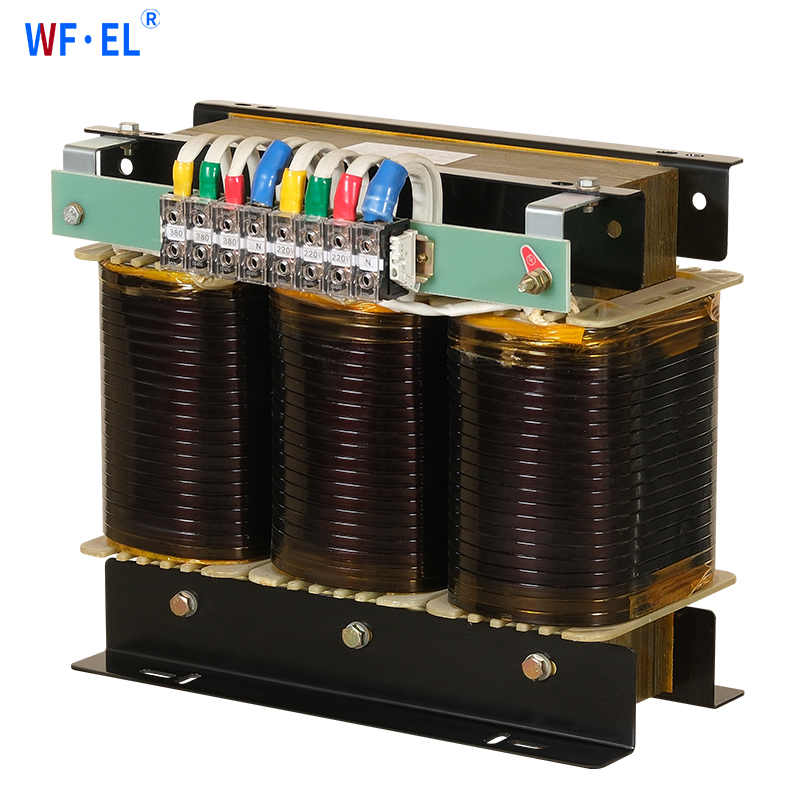
SVSG-30KVA
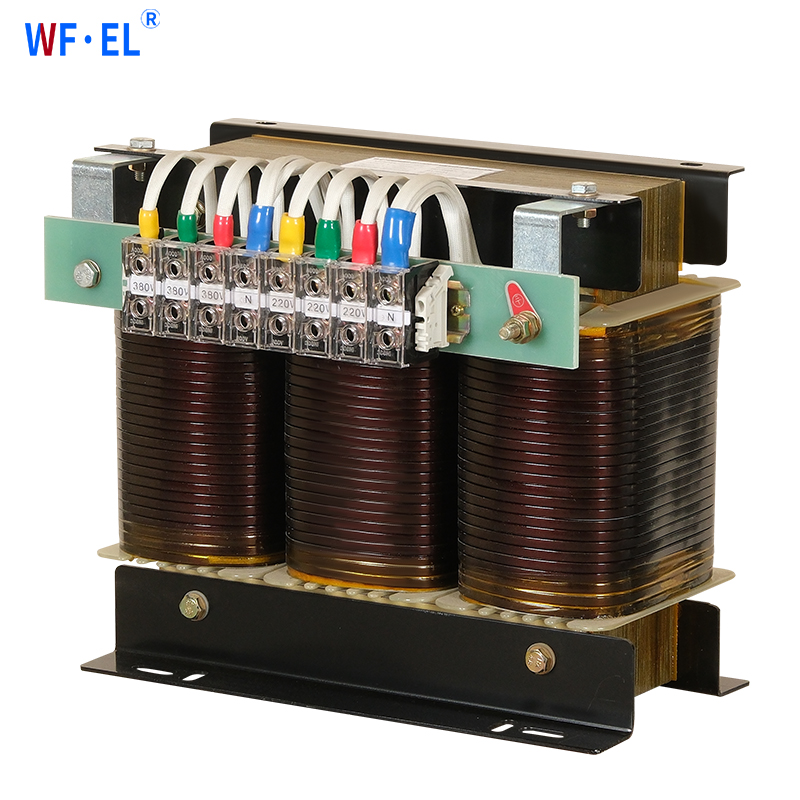
SVSG-10KVA
Technical Comparison
Choose the right transformer based on your power requirements
| Specification | Single-Phase | Three-Phase | Auto-Transformer | Isolation |
|---|---|---|---|---|
| Efficiency (Full Load) | 98.0% - 99.0% | 98.5% - 99.5% | 99.0% | 97.5% |
| Typical Power Range | 0.5 - 50 kVA | 15 - 2500 kVA | 1 - 100 kVA | 0.1 - 20 kVA |
| Noise Level | <40 dB | <50 dB | <45 dB | <35 dB |
| Installation Cost | Low | High | Low | Medium |
| Maintenance Interval | 5 years | 3 years | 5 years | 7 years |
| Weight (100kVA) | N/A | 280 kg | N/A | N/A |
| Voltage Isolation | Yes | Yes | No | Yes (High) |
| Footprint (100kVA) | N/A | 0.8 m² | N/A | N/A |
| Best For | Homes, Shops | Factories, Buildings | Voltage Matching | Medical, Audio |
Technical Specifications
Key features of Wenfei three-phase transformers
Three-Phase Power
Delta or Wye configurations from 208V to 480V with balanced load distribution across all phases
Heavy-Duty Design
Class F (155°C) or Class H (180°C) insulation with IP23-IP54 protection for industrial environments
High Overload Capacity
1.25x rated current continuous operation, 1.5x for 120 seconds with advanced thermal protection
Industrial Grade Cooling
<50dB at 1 meter with forced air or natural cooling, suitable for factory floor installations

Ideal Applications
Where three-phase transformers excel
Manufacturing Plants
Factories, production lines, assembly plants--powering CNC machines, conveyors, and heavy equipment
Commercial Buildings
Office towers, shopping malls, hotels--HVAC systems, elevators, and large-scale lighting
Infrastructure Projects
Data centers, hospitals, rail systems--critical power distribution for mission-critical operations
Three-phase Transformer FAQ
Expert answers to common three-phase transformer questions
What are the typical applications for three-phase transformers?
Common Applications:
- Industrial: Manufacturing plants, motor drives, production lines (50-2500 kVA)
- Commercial: Shopping malls, office buildings, data centers, hospitals (100-1000 kVA)
- Power Distribution: Substations, grid networks, utility distribution (up to 10 MVA)
- Infrastructure: Rail transit, metro systems, tunnels, airports
- Renewable Energy: Wind farms, solar power plants, energy storage systems
- Mining & Oil: Drilling rigs, processing facilities, pumping stations
💡 Tip: Three-phase systems provide 1.732x more power than single-phase at same current, making them ideal for heavy machinery and continuous industrial loads above 10 kW.
How do I select the right kVA rating for a three-phase transformer?
Calculation Steps:
- Calculate Total Load: Sum all three-phase equipment power (kW)
- Convert to kVA: kVA = kW ÷ Power Factor (typically 0.8-0.95 for industrial loads)
- Add Diversity Factor: Multiply by 1.2-1.5 for motor inrush, harmonics, and future expansion
- Example: 80 kW load ÷ 0.85 PF × 1.25 = 117.6 kVA → Select 125 kVA or 160 kVA transformer
Quick Reference (400V Secondary):
- • 100 kVA: Up to 144A per phase (small workshop, 5-10 machines)
- • 315 kVA: Up to 455A (medium factory, multiple production lines)
- • 630 kVA: Up to 909A (large industrial plant, heavy motors)
- • 1000 kVA: Up to 1443A (commercial complex, data center)
- • 2500 kVA: Up to 3608A (substation, industrial park distribution)
⚡ Note: For VFD-heavy environments or non-linear loads (rectifiers, UPS), add 20-30% extra capacity for harmonic derating. Contact Wenfei for detailed load analysis and K-factor rating.
What winding configurations are available for three-phase transformers?
Delta-Wye (Dyn11) - Most Common
- • Primary: Delta (Δ) connection
- • Secondary: Wye (Y) with neutral grounding
- • Phase Shift: 30° lag (11 o'clock vector group)
- • Applications: Distribution transformers, step-down from 10kV/11kV to 400V/230V
- • Advantages: Suppresses 3rd harmonics, provides neutral for single-phase loads, unbalanced load handling
Wye-Wye (Yyn0)
- • Both Sides: Wye (Y) connection with neutral
- • Phase Shift: 0° (in-phase)
- • Applications: High-voltage transmission, grounded systems
- • Advantages: Lower insulation stress, economical for high voltages
- • Note: Requires grounding, susceptible to 3rd harmonic issues
Delta-Delta (Dd0) & Wye-Delta (Yd11)
- • Dd0: No phase shift, no neutral, good for balanced loads (motor drives, rectifiers)
- • Yd11: Step-up configuration, wind/solar to grid connection, 30° phase shift
- • Advantages: Delta blocks zero-sequence currents, continues operation with one phase open
Standard Voltage Combinations:
- 10kV/0.4kV (Dyn11) - China standard distribution
- 11kV/0.415kV (Dyn11) - Southeast Asia, Middle East
- 20kV/0.4kV (Dyn11) - European MV networks
- 35kV/10kV (YNyn0) - Substation step-down
🔧 Customization: Wenfei manufactures any vector group (Dyn11, Yyn0, Dd0, Yd11, Dy11, etc.) and voltage combination. Provide system voltage and grounding requirements for optimal configuration.
What is the difference between dry-type and oil-immersed three-phase transformers?
Dry-Type Transformers:
- Insulation: Epoxy resin cast or VPI (Vacuum Pressure Impregnated) windings
- Cooling: Air natural (AN) or forced air (AF), Class F/H insulation (155°C/180°C)
- Capacity: Typically 30-2500 kVA, up to 35kV voltage class
- Advantages: Fire-safe (no oil), low maintenance, indoor installation, environmentally friendly
- Disadvantages: Higher cost (~20-40% more), larger size, lower overload capacity
- Best for: Buildings, hospitals, metros, tunnels, fire-sensitive areas, indoor substations
Oil-Immersed Transformers:
- Insulation: Mineral oil or bio-based ester fluid
- Cooling: ONAN (natural), ONAF (forced air), OFAF (forced oil+air)
- Capacity: 50 kVA to 100+ MVA, up to 220kV voltage class
- Advantages: Lower cost, better cooling, higher overload tolerance (125-150%), longer lifespan
- Disadvantages: Fire risk, requires oil maintenance, environmental concerns, outdoor installation preferred
- Best for: Outdoor substations, industrial plants, power grids, high-capacity applications
Cost Comparison (500 kVA, 10/0.4kV):
- • Dry-Type: $8,000-12,000 (cast resin), minimal maintenance
- • Oil-Immersed: $5,000-8,000, plus oil testing ($200/year)
- • Total 20-Year Cost: Often similar when including installation and maintenance
🌳 Trend: Dry-type transformers gaining market share in urban areas due to safety regulations. Wenfei offers both types with identical electrical performance and 25+ year design life.
How do I maintain a three-phase transformer and maximize efficiency?
Maintenance Schedule:
- Weekly (High-Load): Infrared thermography scan for hot spots, check load balance across phases (±10% max)
- Monthly: Visual inspection (oil leaks, abnormal noise, bushing cracks), verify cooling fan operation
- Quarterly: Measure phase voltages/currents, test temperature rise, inspect cable terminations
- Annually: Insulation resistance test (≥1000 MΩ for dry-type), tighten all connections, clean air ducts/radiators
- Every 2 Years (Oil): Oil dielectric test (≥30 kV), dissolved gas analysis (DGA), moisture content (<30 ppm)
- Every 5 Years: Winding resistance, turns ratio, vector group verification, partial discharge test (dry-type)
Efficiency Optimization:
- Load Management: Operate at 50-80% rated capacity for peak efficiency (typical η = 96-98%)
- Power Factor Correction: Install capacitor banks to maintain PF > 0.95, reduces losses by up to 15%
- Phase Balance: Keep phase currents within ±5%; unbalance causes circulating currents and overheating
- Voltage Optimization: Use on-load tap changers (OLTC) to maintain ±2% voltage regulation, improves downstream equipment efficiency
- Harmonic Mitigation: Install filters for VFD/rectifier loads; harmonics increase losses by 10-20%
- Ambient Control: Maintain <40°C ambient; every 10°C rise increases losses by 6-8% and halves insulation life
Wenfei Energy-Efficient Models:
- • Class 1 Efficiency (GB/T 10228): No-load loss <0.2%, load loss <1.5% at rated capacity
- • Amorphous Core Option: Reduces no-load loss by 70% vs. silicon steel (payback in 3-5 years)
- • Smart Monitoring: IoT sensors track temperature, load, oil quality with mobile alerts
🔧 Service: Wenfei offers 24-month warranty, lifetime technical support, and annual preventive maintenance contracts. Our transformers achieve 99.5%+ uptime with proper care and 30+ year operational life.
Three-Phase Transformer Industry
Trends for 2026
Published: January 2026
The Evolution of Three-Phase Transformer Technology
The three-phase transformer market is experiencing unprecedented growth in 2026, driven by rapid industrial expansion, large-scale renewable energy projects, and the global shift toward electrification of heavy industries. As manufacturing facilities, commercial complexes, data centers, and utility-scale power grids demand robust and efficient power distribution, advanced three-phase transformers are becoming critical infrastructure for high-capacity energy transmission, voltage conversion, and seamless integration with wind farms, solar parks, and energy storage systems.
1 Ultra-High Efficiency & Low-Loss Designs
Modern three-phase transformers utilize amorphous metal cores, grain-oriented silicon steel, and optimized winding architectures to achieve efficiencies exceeding 99.5% while reducing no-load losses by up to 70% compared to conventional designs. These high-performance units are essential for industrial plants, power substations, and renewable energy farms where energy savings directly impact operational costs. By 2026, ultra-efficient three-phase transformers with Tier 1 energy ratings are projected to dominate 65% of new industrial and utility installations, offering payback periods under 3 years through reduced energy consumption and lower carbon emissions.
2 Digital Twins & Predictive Maintenance
Next-generation three-phase transformers feature integrated IoT sensors, AI-powered analytics, and digital twin technology enabling real-time monitoring of temperature, load profiles, insulation health, and partial discharge activity. Utilities and industrial operators can predict failures 6-12 months in advance, schedule maintenance during planned outages, and extend asset lifespan by 40%. Smart three-phase transformers with cloud-based diagnostics and automated fault location are becoming standard in critical infrastructure applications, reducing unplanned downtime by 80% and maintenance costs by 55% across power generation, transmission, and heavy manufacturing sectors.
3 Renewable Energy & Grid Modernization
Three-phase transformers optimized for renewable integration feature wide voltage tolerance, harmonic filtering, and dynamic load balancing capabilities essential for utility-scale solar farms, offshore wind parks, and grid-scale battery storage. These specialized transformers manage bidirectional power flow, voltage fluctuations from intermittent generation, and reactive power compensation. With global renewable capacity growing 220% annually, renewable-ready three-phase transformers are experiencing record demand, particularly in markets with aggressive decarbonization targets and large-scale green energy investments. By 2026, over 70% of new wind and solar installations will utilize smart three-phase transformers with integrated grid-forming capabilities.
4 Enhanced Reliability & Extreme Environment Performance
Modern three-phase transformers incorporate advanced cooling systems, seismic-resistant designs, and climate-adaptive insulation materials that ensure reliable operation in temperatures from -50°C to +60°C, high-altitude installations, and corrosive coastal environments. Oil-immersed units with biodegradable ester fluids and dry-type transformers with Class H insulation withstand extreme conditions while meeting stringent environmental regulations. These ruggedized designs are critical for mining operations, offshore platforms, desert solar farms, and Arctic infrastructure projects. By 2026, climate-resilient three-phase transformers will represent 45% of deployments in harsh environments, offering 35+ year service life with minimal maintenance.
5 Customization for High-Power Applications
Three-phase transformers are increasingly available in application-specific configurations including distribution, power, rectifier, isolation, and auto-transformer designs for specialized industrial processes. Customizable power ratings from 10 kVA to 500 MVA, voltage classes from 400V to 765 kV, and specialized features like on-load tap changers, harmonic suppression, and fault-limiting capabilities are driving market diversification. By 2026, custom-engineered three-phase transformers will represent 50% of total shipments, serving critical applications in data centers, electric arc furnaces, rail traction systems, petrochemical plants, and utility substations requiring precise voltage regulation and high fault tolerance.
Wenfei's Three-Phase Transformer Innovation
Wenfei Electrical's 2026 three-phase transformer series combines industrial-grade reliability with cutting-edge efficiency. Our product lineup features high-performance amorphous and silicon steel cores, advanced cooling systems with IP54-IP65 protection, and optional smart monitoring modules with predictive analytics. Supporting voltage configurations from 400V to 35 kV with power ratings from 10 kVA to 10 MVA, our transformers excel in industrial distribution, renewable energy integration, rail transit, tunnel construction, and utility substations. With over 150,000 units deployed across manufacturing, infrastructure, and power generation sectors in 60+ countries, Wenfei is your trusted partner for three-phase power transformation solutions.
Explore Our Three-Phase Transformer SeriesWant to stay updated on three-phase transformer trends and Wenfei innovations?
Industrial Power Solutions
for Your Facility
Contact Wenfei's engineering team for customized three-phase transformer solutions. We provide load analysis, technical specifications, installation planning, and competitive quotes for industrial and commercial projects worldwide.